Showing posts with label Frieda Anderson. Show all posts

24 April 2012

Artist's Block

I'm on vacation. I have big plans. I'm burning with eagerness to try everything I ever wanted to try. I should have all the time in the world. So what's happening? - Nothing! I've been suffering from the most awful artist's block. Since my last blog entry a week ago I've managed to finish a sock, cut out the muslin pieces for a wrap-around top (no sewing, though), dye two gradations (one which is still batching), try out a fun technique with paintstiks (which I will come back to when I've found a paintstik which isn't past its 'best before' date), and created a sad little square of surface designed fabric. Yes, I know I sound a bit despondent. I feel a bit despondent. I guess I was more in need of a vacation than I realised, and my body just put the foot down and refused to turn on the creative juices. So I just have to take baby steps. It's frustrating, but not the end of the world.

This is the first gradation I've dyed so far. A warmer colour scheme than the last one, with golden yellow, bright scarlet and medium blue (Jacquard Procion MX dye). Click the tags Gradations, Dyecation, Procion MX and Frieda Anderson for more information about gradations. A lighter gradation (gradation 2, i.e.) is ready to be rinsed out, so I'll show you that one in my next blog post. What I like about working with these gradations is that it makes me mix colours that I know I would never have mixed if I had just been doing it on my own. And to my surprise I've realised that those colours that I thought I considered "ugly" are really very useful and not ugly at all. Bright or muddy, light or dark, they all have and deserve a place in the fabric stash!

First gradation, medium value (they look a bit lighter in this photo)


I mentioned a 'sad little square of surface designed fabric'. Well, to be fair, it's really not that sad, but I was a bit disappointed with it, as it didn't turn out the way I expected. I'll walk you through the process. And if you want more details and inspiration check out Melanie Testa's great article Cut from your imagination. Resist-printing fabric with paper 'snowflakes' in issue 21 of Quilting Arts Magazine.

First I printed a hand dyed piece of fabric with bubble wrap and discharge paste:


Then I applied a Magic paper (freezer paper) 'snowflake' resist:


Here's the result after applying fabric paint (dark green, metallic green and gold):


You can see the problem, right? What I should have realised when I was applying the paint is that I was working with the background. I think I would have got away with it if I'd stopped after the metallic green paint, but I felt like adding a bit of glitz, and that was too much. The gold paint jumps forward and since it's similar in value to the the resisted leaves, it obscures the resisted pattern.

I spent some time mulling over the problem and going through different ways to solve it and save the fabric, and this is what I ended up doing: I grabbed a green Multimark pen and drew in the contours of the resisted motifs.


I'm not wild about it, but it's better, it works, and it taught me a valuable lesson about contrast. Something I'm wild about, however, is the snowflake:


If I don't use it as resist in another piece, I'll glue this one into my sketchbook. I love the metallic sheen on the paper.

Thanks for following my adventures in surface design. There's more to come soon. Flour-resist. That's all I'm saying. ;-)

Have a great week! - Annika

4 March 2012

Procion MX Dyes - a short explanation

I've just rinsed the last gradation, and next I intend to use up the last of the dye I mixed on Tuesday. First, however, I'll get back to what I promised yesterday: a simple explanation about Procion MX dyes to those of you who are unfamiliar with them:

Procion MX dyes are fibre reactive dyes, which means that they don't just sit on the fibres, but actually bond with the fibres through a chemical reaction. Procion MX dyes come in a powder form and you mix them with water in different concentrations depending on how bright or light you wish the colour to be. I started by mixing basic dye stock from the three primary colours yellow, red and blue (lemon yellow, fuchsia and turquoise):


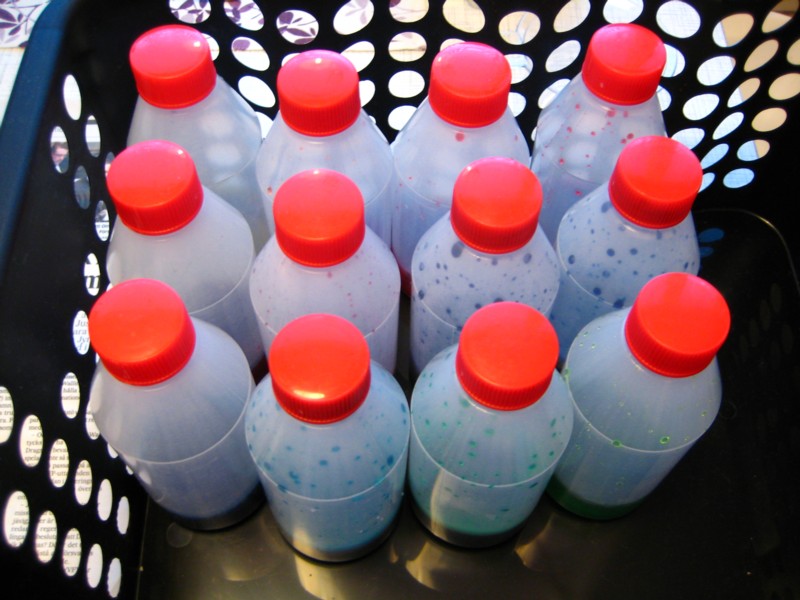
This dye stock was used in different quantities to mix secondary colours such as orange, violet and green. I mixed 12 colours before I started dyeing and put each in its own little bottle:


In order for the dye to bond with the fabric you need to add a fixative. With Procion MX dye you use soda ash or washing soda. You can add it to the dye itself, or to the fabric. In the gradation process I've done you soak the fabric in a solution of soda ash before you start dyeing.

I did the gradations in the following manner. First I put the fabric in a large tub and then I poured the ready-mixed dye (from the 12 small bottles) over it. I turned the fabric around in the dye to cover it well.


When the fabric was evenly covered with dye I put it in one of the ice cream tubs.


The dye needs moisture, warmth and time in order to bond with the fabric. Therefore I put the lid on the container and put the container in the warmest place in my home: the cupboard on top of the refrigerator. This process is called batching. I let my fabrics batch for about 24 hours.


When the fabric has batched long enough you rinse it out and wash it to get rid of loose and unbonded dye particles.

I hope this has explained the basics of the dyeing process that I've explored this week.

Tomorrow it's back to the old grinding wheel again. A week passes by so quickly, and I haven't accomplished nearly as much as I thought I would. But I'm pretty content anyway. It has been a joy to work with so much colour, and it feels like spring has sprung a little in advance in my home.

Thanks for stopping by. I will publish the results from the dark gradation soon, so stay tuned. - Annika

3 March 2012

Let There Be Lights

Here's the second gradation that I've done from the same three primary colours that were used for the first gradation (lemon yellow, fuchsia and turquoise), only this time the dye is diluted with water to make lighter values.


These 'mystery fabrics' were made with leftover dye


The third and final gradation (dark value) is now batching in the same old icecream tubs as the other ones before it. I've certainly practised my rinsing skills this week.

As I know that some of you readers are unfamiliar with Procion MX dye, I've decided to write a blog post that I hope will explain things a little. But that will have to wait for tomorrow, because I feel I've had enough of dyeing for one day. I think I'll just sit down, put my feet up and do something completely different.

Have a great weekend! - Annika

1 March 2012

Greeted by a Rainbow

When I climbed out of bed this morning I was greeted by a rainbow.


A few more steps and I was met by this glorious sight.


I felt pure happiness. 

I believe that I’m severely colour-starved. For the last 4 months my world has just been brown, grey, black, white, muddy, slushy, dull, uninspired. Don’t get me wrong, I like winter. It can be absolutely beautiful. But you don’t get a lot of colour, do you? I’ve been reminiscing about last year’s trip to Thailand and all the gorgeous colours you see there. Playing with dye the past couple of days has made me realise how much I have missed colour. When I saw these tulips in the supermarket yesterday, I grabbed them. I love the combination of orange, purple and green. 


On Tuesday I started dyeing a 12-step gradation. I’m following Frieda Anderson’s instructions from her book ‘Fabric to Dye For’, and I started right from the beginning with a medium value gradation based on lemon yellow, fuchsia and turquoise. First of all, let me tell you that I grossly misjudged how long it takes to dye fabric. I’ve dabbled in dyeing before, in a happy-go-lucky style, but this time I decided to be a bit more scientific about it. (I even keep a dyeing notebook!) So, my first ambitious plan was to first do three gradations of a bright colour scheme, and after that three gradations in a warm colour scheme. Well, reality forced me to think again. I was knackered on Tuesday, and woke up with a splitting headache on Wednesday. I had crammed so much new knowledge in my head that it was practically bursting. So I gave myself a break and went out for a walk in the sunshine instead of carrying on with my over-ambitous plans. In the evening I rinsed out the fabrics and here’s the result of the first gradation (brights, medium value). 


These skinny quarters of fabric will be great as the base for further surface design techniques, such as printing, overdyeing, discharging and so on. Or I might make them into a little rainbow quilt for my wall. They make me happy. 

Look, even the trash looks great. 


However, my favourites are the mystery fabrics I created out of leftover dye.


Tonight I did the second gradation, with light values. The fabrics are happily batching in their little tubs right now, while I'm relaxing with my blog. I'll rinse out the fabrics tomorrow, and will probably do the third gradation (dark values) on Saturday.


In case you wonder what has happened to the Emo-experiment, I can reveal that it went well, and that I will report back within soon.


Thanks for visiting my blog, and see you again soon with more results from my dyecation. - Annika

28 February 2012

Another Report from My Dyecation

It's been a labour-intensive day today, and I'm pretty knackered, so I'll just illustrate part of my day with a few images and words, and return with more images and text tomorrow or in a couple of days.

Setting up my work space for mixing dyes


Protecting myself as well


Primary colours mixed and ready to use
(lemon yellow, fuchsia and turquoise)


Sixteen ice cream tubs of yummy fabrics batching away. 

Four of the tubs contain 'mystery fabric', i.e. fabrics that are coloured with leftover dye. Now I have to wait patiently until tomorrow before I can rinse them out.

See you again soon! - Annika