Showing posts with label Embroidery. Show all posts

11 April 2021

Universe Inside - Deep-Sky Object ALC 4

I can’t believe that it has taken me so long to sit down and write this blog post about a quilt I finished in July last year. Especially since the subject matter is the astroquilt that is my personal favourite so far. Or perhaps that is the reason: it means so much to me that I got blocked. Or perhaps it’s the pandemic, and the fact that it pulled the rug from under my feet, and has left me feeling tired and lost. Probably it’s both these reasons and a few more…

On my project blog you can follow my progress on this quilt step by step, so I won’t talk about that here. Instead, I want to talk about the symbolism in the quilt and what it means to me.

The title of this quilt is ‘Universe Inside’, and it alludes to both the brain inside our heads and the cosmic web that is formed by all the galaxies in the universe.

The first time I saw an image of the cosmic web I was first awe-struck, and then I drew a parallel to the neural network of our brain. Both are amazing. Our brain has the capacity to process enormous amounts of information on a both conscious and subconscious level, and when it comes to imagination, there are hardly any limits. We can dream up a whole universe inside our heads. 

So what is the cosmic web? The cosmic web is the name for the structure of our universe. The hundreds of billions of galaxies in the observable universe are not randomly distributed, but held together by gravity in groups, clusters and superclusters that, in their turn, form filaments of galaxies with gigantic voids in between. If you zoom out far enough this structure looks like a web, or rather sponge, where everything is connected. The thought arises: is there a cosmic consciousness? Is this the brain of the universe? This is where astronomy brushes up against philosophy and spirituality.

The cosmic web (image from Wikimedia Commons)

 I am deeply moved by the cosmic web and how the whole universe is connected, and that I am a conscious part of all this. In fact, it moves me to tears, because of its beauty and enormity. This is why I chose to include myself in this quilt. The female profile is my face. The cosmic web has replaced the network of brain cells inside my head.


The quilting on my cheek and neck is one of my favourite quotations and by the astronomer Carl Sagan: “The universe is within us. We are made of starstuff. We are a way for the universe to know itself.” What this means is that all the elements that out bodies are made of have come from stars that have existed and died. Stars are factories of heavier and heavier elements, and when a star dies it throws all these elements out into space, where they can be reordered into new stars, planets and living beings such as you and me.


The quilting in the background is a mandala. A mandala is a symbolic representation of the cosmos, and of the connection between the self and the universe. It is often used for meditation practises, to help with focus and as a spiritual guidance. It seemed to me that it was the perfect way to tie this quilt together: mandala – brain – self – universe.

You will find all process images here.

Thanks for visiting my blog!


5 April 2020

Black Hole – Deep-Sky Object ALC 3

Black Hole
34 x 34 cm (13,5" x 13,5")


This is my third astroquilt, and the second in a series of astroquilts that combine space and human anatomy. The first in the series is The Heart Nebula, which is an anatomical heart floating in space and pumping stars out into the cosmos. In Black Hole you see a human eye with a black hole instead of a normal pupil. A black hole in space is a complex and fascinating object, and if you want to know a little more about what a black hole is and why I have chosen to depict in in this manner, follow this link to my project page and scroll down to 17 February 2020.


I had a lot of fun with this quilt, playing with different concepts and creating layers of meaning. Apart from the idea of the black hole itself, one thread (pardon the pun) in this quilt is Einstein’s so called field equations. These are a series of equations within the general theory of relativity, which describe the spacetime curvature and lead to the prediction of black holes. Since they are highly relevant for my subject matter, I chose to use parts of these equations for the quilting in the background and in the iris.


Spacetime curvature, i.e. the idea that spacetime is not straight and flat, but warped by massive objects, is also present in the white of the eye and the eyelid, where I used quilting lines to describe the curvature of the surface. There is, however, also another element in the white of the eye and the iris, which alludes to the eye as a camera, where the pupil is the aperture and the iris the aperture stop which controls the amount of light that is admitted into the eye/camera. The lines that curve in from the outer edge toward the black hole symbolise the moving parts of the aperture stop and the muscles in the iris, which contract and expand the opening, as well as the gravitational force that inexorably pulls even light into a black hole, from where there is no escape.


The eye is a very powerful symbol that in itself has many layers of meaning in e.g. folklore (the evil or spellbinding eye), romance (drowning in someone’s eyes) and communication (look someone straight in the eye). I really enjoyed adding another symbolic layer to the eye by introducing the concept of the black hole.


These are the main ideas that I played with in the making of the Black Hole quilt. If you want to follow the process behind the quilt step by step, please visit my project page or check out my Instagram feed.

Thank you for visiting my blog!

9 October 2019

The Heart Nebula – Deep-sky Object ALC 2

The Heart Nebula
34 x 34 cm (13,5" x 13,5")


This quilt is the second in a series of astroquilts that I’ve got planned. The first quilt in the series is titled Cosmos and you can read about the process behind it on this blog (Cosmos Part 1, 2, 3 and 4) and in the Autumn 2019 issue of Art Quilting Studio magazine.

Cosmos, detail


This second astroquilt was inspired by a nebula called the Heart Nebula (IC 1805), which is located about 7 500 light years from where we are. The shape of this interstellar dust cloud resembles the heart symbol, and that’s how it got its name. It was in fact the name that caught my attention, but not as the romantic heart-shape it was named after. Instead, I was interested in the anatomical, blood-pumping, tough muscle that keeps us all going.

The human heart is a complicated old thing


A nebula is an interstellar cloud of dust and gas. When a cloud like that is dense enough the pressure may become so great that the cloud starts to contract and it becomes a stellar nursery: a place where new stars are formed. I wanted to make a Heart Nebula quilt where the pressure inside the contracting heart muscle is so great that stars are forming and the heart begins to pump out stars.


The mathematical symbols in the background represent ”Jeans mass”:  the critical point when a nebula starts to contract and form stars. I’ve also included a representation of the sinus rhythm: the rhythm of the heart starts at the sinus node, which has the ability to spontaneously and continuously produce electrical impulses that cause the heart to contract.


If you want to follow the process behind this quilt step by step, please visit my project page or check out my Instagram feed.

Thanks for visiting my blog!

30 March 2019

Cosmos, Part 4

Welcome back to the fourth and final part of the story behind Cosmos! For me, the last stage of making an art quilt usually involves hand stitching, and that is what this blog post is all about.

The road that led me to work this way started with free-motion machine embroidery, which led to free-motion machine quilting, but it was not until I realised that I could combine machine and hand stitching that things fell into place and I felt I’d found my place in the world of art quilting. I feel that hand stitching is a wonderful complement to machine work, and above all it brings life and depth to a surface in a way that machine stitching can’t mimic. It is slow work, yes, but satisfying on so many levels.

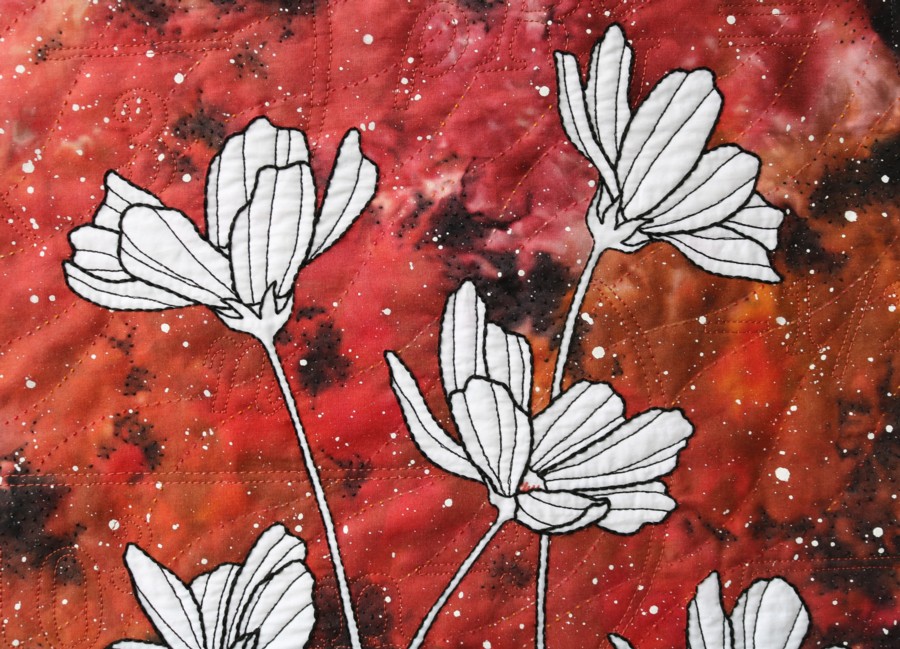
So after I’d finished all the machine work, it was time to hand stitch the flowers. I’d already tried out my stitches on a sample so the outlines were pretty straightforward: 5 strands of embroidery floss for the flower heads and 3 strands for the stems. I really enjoyed stitching the flower heads and I made good progress.

See me hand stitch a flower on Instagram


When it was time to do the stems I hit a wall, though. It was mind-numbingly tedious to stitch seemingly endless straight lines and I had to figure out rewards for myself to keep going.


The long-term reward was the thought that as soon as I’d finished the stems I would be allowed to use the threads I’d dyed for the background.


The instant reward was that I allowed myself a break to think about the middle of the flowers. I did one flower, but wasn’t happy with how it looked, so I printed a number of flowers on paper, drew different versions of how the stitching could be done and auditioned them on the quilt.

See me audition the flowers on Instagram

This helped me decide how to deal with the flowers. The bottom version is the one I chose.


I can sometimes be extremely finicky with details, and in the following case I didn’t like the angle of the stitches on the flower to the left. So I unpicked them and tried slanting them the other way. The difference is subtle, but the one to the right feels right to me.


When the flowers were finished it was time to think about the hand stitching in the background. By now I’d realised that I was going to do a lot more hand stitching than what I’d originally planned. Partly because there was a bit too much unquilted surface after the machine quilting was finished, and partly because I’d come up with an idea that I was really excited about: I was going to stitch tiny seed stitches with black on black that would represent ‘dark matter’. It is believed that 95% of the universe consists of dark matter and dark energy. It is called ‘dark’ because no one really knows what it is - yet. I wanted the dark matter on the quilt to be almost invisible too, so that you could only spot it when it caught the light, or if you touched the quilt.


Dark matter is more easily spotted if you sneak up on it from behind


As I said, I was really excited about the idea of dark matter, but it was hard going. It was even more tedious than the flower stems and pretty hard on my eyes and neck. And of course, when you work on something like this and reflect on the fact that you spend so much time working on something that will hardly even be noticed, you start questioning your own sanity, and why on earth you do certain things… So I took another break and worked on what I called ‘background radiation’, where I could use more cheerful colours and the stitching was easier. Head over to this post on Instagram if you want to know more about cosmic background radiation, but in just a few words, it is leftover radiation from the Big Bang. I wanted to depict it as lazy wavelengths that went diagonally over the nebula in the background.


When the background radiation was finished there was nothing else to do but to roll up my sleeves and finish the dark matter. By now I’d had time to think about my situation, and one thing that I’d come to realise was that the reason why I love to work with textiles, even though it’s so much slower than if I’d paint the same motif on canvas, is the tactile nature of fabric and fibre. It feels good in my hands. I mentioned my eyes earlier, and being a visual person the thought that I may lose my eyesight one day pretty much freaks me out. Working with the dark matter, though, suddenly brought a sense of comfort. Hand stitching on fabric can be like braille, and if there comes a day when I can no longer see what I stitch, I can feel it instead.


And just like that the last particle of dark matter was in place and all that was left was to square the quilt and finish the edges. When I make art quilts I like clean edges and therefore I usually finish them with facing strips. And, of course, I wanted the facing to complement the quilt, so I spattered white paint on black fabric for stars before I cut the strips.


Finally, I attached a hanging sleeve, and I will soon design a label with the title and date as the final detail.

So that was it. It’s been a long journey and I will have a short break before I get started with the next quilt. But I already have plans, and those who follow me on Instagram and Facebook will know that the theme for my next art quilt will be ‘Black Hole’. I’m very excited to find out where that will take me.


Thank you so much for following my journey! I’m not sure when I will write the next blog post, but I will continue to post regular updates on Instagram and Facebook, so I hope to see you there!

All the best,

19 March 2017

She Has Flowers in Her Hair

I'm gearing up to get started on some new fabric art projects. I said 'gearing up', and that is really a more active-sounding euphemism for 'procrastinating'. But procrastination isn't all bad: I do accomplish a bit of this and that while 'gearing up'. I've rescued a knitted vest from the UFO pile. I've returned to an unfinished sock project. I've had my sewing machine serviced. I've decluttered my messy home (a bit). I've actually started cutting up and using some of all the old t-shirts that I've saved over the years to crochet a small rug. And now I'm going to blog about an art quilt I made last year. I can't believe I haven't done it already, but that's how it is. It fell between the cracks, and it's only now that I'm 'gearing up' for my next quilt, which will also be a portrait (of a mermaid), that I remembered I still haven't blogged about the last one.

So before I sail off to join the mermaids, I'll show you what I did about a year ago, when I made my flower lady quilt. I reckon I will use basically the same process for the mermaid quilt.

It all started with a watercolour painting in one of my art journals:


Before I start working on the actual quilt I like to research my methods and make samples. I hadn't used Derwent Inktense pencils in an art quilt before so I did some tests to find out how they would work.


I like to work with layers in my art quilts, and it's fascinating to see how the individual layers, which often don't make much sense on their own, will make perfect sense when combined. I'm sure there's a metaphor of something important hiding in that observation.

The bottom layer with fused raw-edge and painted appliqué


The silk organza top layer, spray painted, and with a freezer paper mask to protect the face


Silk organza, spray painted and further enhanced with Inktense pencils


The layers combined


Free-motion machine quilting in progress


Machine quilting finished


Hand stitching to add final details


The finished art quilt, which I've had the fortune to be able to display in three exhibitions so far.


I loved working on this quilt, and now I'm really looking forward to getting started on my next girl! Yay!

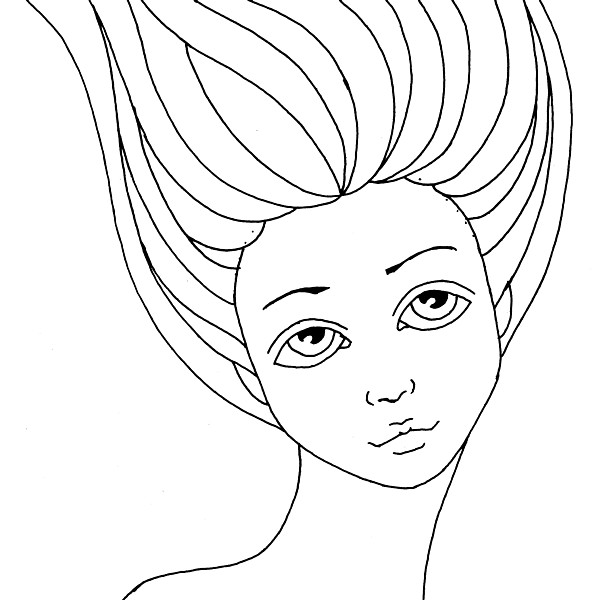
My plan for a mermaid quilt


I want big eyes, but I think I overdid it a little this time, so it needs a bit of tweaking. But I'm excited to be on my way. I'm also planning a mermaid doll. Yes: mermaids are The Thing for me right now, and I'll go with the flow, follow the tide, dive in and immerse myself in the subject. 😊


Thank you for dropping by and I hope to see you again soon!